KaolackCreations
African necklace Guele Djiri wooden beads and Akan weights
African necklace Guele Djiri wooden beads and Akan weights
Couldn't load pickup availability
- Livraison offerte dès 99 € (France et UE)
- Expédié de Paris, avec suivi
- 14 jours pour renoncer à votre achat
This African wooden bead necklace brings together two ancient traditions from West Africa: Guele Djiri beads from Mali and Akan bronze weights from Ghana and Côte d'Ivoire.
Five designs were created for this collection: Sankofa, Gye Nyame, Akan Mask, Akan Weight, and the Guele Djiri short necklace. Each carries a specific cultural reference and a contemporary line.
The beads are carved from African ebony wood and neré wood, two dense species recognized for their deep color and their presence in protective adornments in the Manding world. The bronze elements refer to the Akan tradition, where weights were once used to measure gold dust used as currency.
This necklace combines spiritual dimension, cultural memory, and contemporary expression. It can be worn alone or layered. The mounting on a triple reinforced elastic band allows for easy threading. Unisex model.
Guele Djiri beads from Mali
In several regions of Mali, certain wooden beads are called Guele Djiri. They appear in personal adornments and in objects related to protection or social identity.
Meaning of Guele Djiri
In the Bambara (Bamanan) language of Mali, the expression Guele Djiri refers to the idea of hard wood or very resistant wood. The word jiri means tree or wood, while guele evokes strength and solidity. The African wooden beads used in these necklaces are carved from dense species such as African ebony or neré. In several Mandé traditions of West Africa, traditional wooden beads are associated with protection, stability, and anchoring. Wearing a wooden bead necklace is part of an ancient relationship between natural materials, everyday objects, and certain cultural practices where wood, a living material from the tree, symbolizes strength and continuity.
For these necklaces, the beads are carved from:
- African ebony – dense wood with a deep color
- Neré wood – dark wood used in Sahelian adornments
These woods visually structure the necklace through their texture and color. In several Manding traditions, they are also associated with protective uses.
Akan weights: measuring gold before colonization
The pendants and metallic elements of these necklaces are Akan bronze weights.
Before European colonization, the Akan kingdoms of Ghana and Côte d'Ivoire used gold dust as currency. Merchants weighed it with a balance and a series of bronze weights corresponding to precise units.
These objects were not merely utilitarian. Their shapes represented animals, everyday objects, or symbolic figures referring to proverbs, moral principles, or important ideas in Akan society.
Today, these forms continue to exist in art, jewelry, and cultural objects inspired by Akan heritage.
Adinkra Symbols
Some models feature an Adinkra symbol, a visual system from Akan culture.
Gye Nyame – Expresses the sovereignty of the Creator and trust in a higher power.
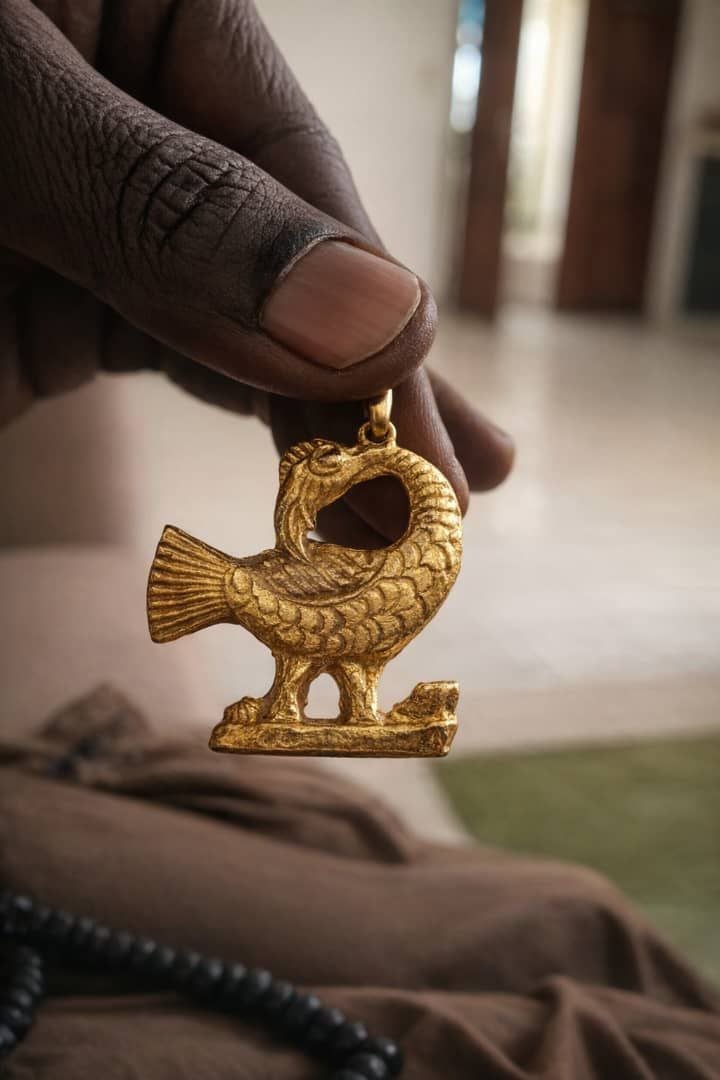
Sankofa – Represented by a bird looking backward, this symbol reminds us of the importance of looking to the past to understand the present and build the future.
These symbols still appear today in textiles, cultural objects, and architecture in Ghana.
The five models of the collection
Each necklace was designed to carry a specific cultural reference while maintaining a contemporary line. Lengths vary from short choker models to long versions with Adinkra symbols.
Sankofa Model
Long necklace with Sankofa Adinkra symbol in bronze. Ebony and neré beads.
Length: 78 cm
Gye Nyame Model
Long necklace with Gye Nyame Adinkra symbol in bronze. Ebony and neré beads.
Length: 78 cm
Akan Mask Model
Long necklace with central Akan mask in bronze. 77 ebony and neré wooden beads.
Length: 76 cm
Akan Weight Model
Medium necklace with large circular Akan bronze weight and two small Akan beads. Ebony and neré beads.
Length: 67 cm
Short Guele Djiri Model
Short necklace worn close to the neck. Ebony and neré beads. Elastic mounting adapted to different body types.
Length: 54 cm
Technical Characteristics
- Materials: African ebony wood beads, neré wood beads, Akan bronze weights
- Mounting: triple reinforced elastic
- Cultural origin: Mali, Ghana, Côte d'Ivoire
- Type: unisex necklace
- Weight: 150 g
Wearing and Silhouette
African wooden bead necklaces hold an important place in several West African cultures. Dark woods like ebony give a strong presence to the adornment. Combined with bronze, they create a sharp contrast that works well with both contemporary outfits and African textiles.
This necklace can be worn alone, with other necklaces, or in a more structured silhouette. The different lengths allow you to choose a close-fitting or longer style.
Complementary Jewelry
To create a complete set, this necklace can be paired with the Guele Djiri and Akan weight bead bracelet, which uses the same materials and aesthetic. The Akan weight choker necklace offers a shorter and more structured alternative, ideal for layering with this long model.
Cultural Origin
This necklace combines two important cultural ensembles from West Africa:
- The Manding world, with Guele Djiri beads from Mali
- The Akan world, with bronze weights and Adinkra symbols from Ghana and Côte d'Ivoire
Bringing these forms together in a single piece of jewelry allows for a combined interpretation of wood, bronze, protection, memory, and visual transmission.
This jewelry is part of our Signature Jewelry Collection, which brings together our most accomplished pieces in polished bronze, solid silver, and premium finishes.
Kaolack Créations
Kaolack Créations develops a collection of jewelry inspired by West African cultures. In this necklace, the references are clearly identifiable: Guele Djiri beads from Mali, Akan weights from Ghana and Côte d'Ivoire, Adinkra symbols.
The brand works with ancient cultural forms in a contemporary interpretation, without emptying them of their meaning. Wood, bronze, symbols, and volumes remain central to the jewelry.
Available on kaolack-creations.com and at Kama The Shop in Paris.
Partager