Kaolack Créations
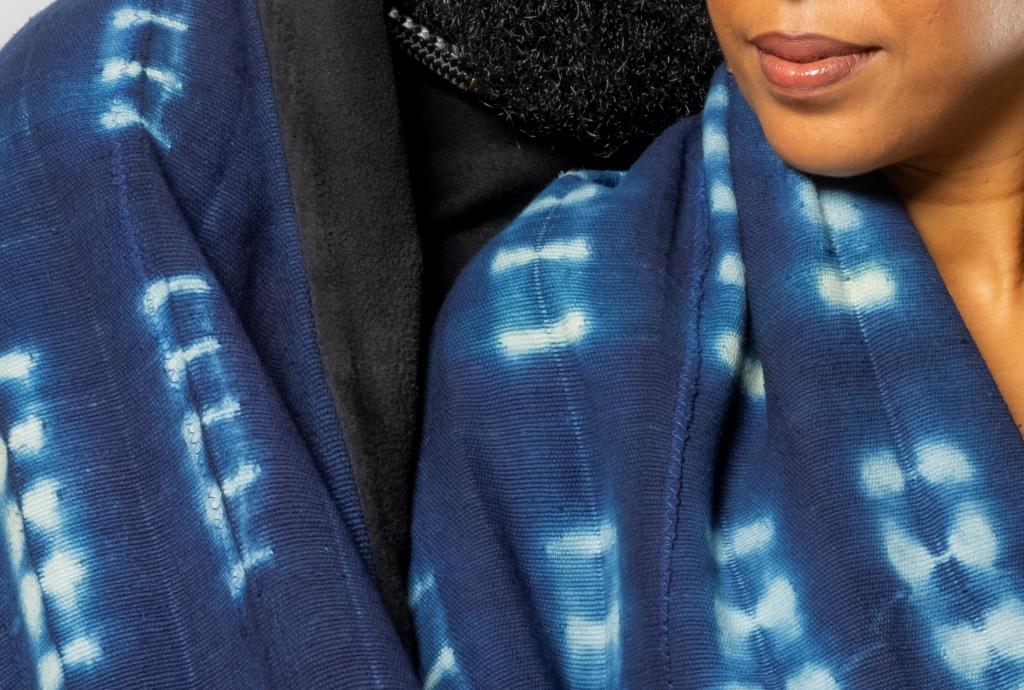
Indigo scarf (galâ / lépi) woven in Mali, fleece-lined – unisex
Indigo scarf (galâ / lépi) woven in Mali, fleece-lined – unisex
Couldn't load pickup availability
- Livraison offerte dès 70 € (France et UE)
- Expédié de Paris, avec suivi
- 14 jours pour renoncer à votre achat
The indigo scarf you'll wear all winter.
Light warmth. Clean drape. Vibrant deep blue.
Handwoven in Mali, dyed with vegetable indigo — called galâ in Mali and lépi in Senegal — then lined with soft fleece for immediate comfort, without excessive bulk.
Its generous size allows it to be worn as both a scarf and a stole, depending on the style and occasion.
Key Features
Natural indigo: vegetable dye, no synthetic pigments.
Handweaving: cotton woven on traditional wooden looms, then strips assembled.
Patterns obtained by dyeing: no prints, no standardization.
Thin fleece lining: gentle warmth, clean drape, everyday comfort.
Dimensions: 0.40 × 2 m (double wrap, shemagh, draped).
Unisex: suitable for all body types.
Responsible production: limited series, dependent on workshop pace.
Two patterns, one savoir-faire
This scarf is offered in two distinct patterns, resulting from the same artisanal weaving and indigo dyeing techniques.
Dotted indigo pattern
Irregular, sometimes cloudy marks that appear during the indigo baths. An organic, lively, never repetitive pattern, where each piece is distinguished by its nuances.
Vertical striped indigo pattern
Structured vertical lines, revealed by weaving and dyeing. The pattern highlights the textile's construction and gives a more graphic interpretation of indigo.
In both cases, the patterns are neither printed nor mechanically reproduced. They result from the gesture, the bath, the thread, and time. Each scarf is therefore unique.
Material & savoir-faire
The cotton is first spun then woven into narrow strips on traditional wooden looms. These strips are then assembled before dyeing.
The indigo baths are made using ancestral vegetable processes: fermentation, natural vats, successive baths. This work gives the blue its depth and natural variations.
In West Africa, the color that the West calls "indigo" has specific names depending on the people and regions. In Mali, it is called galâ — fini meaning "fabric" (galâ fini: indigo-dyed fabric). In Senegal and Guinea-Conakry, this same color is called lépi. Each people has its term: the color is alive, transmitted orally and by gesture, long before the word "indigo" became established elsewhere.
Why choose Kaolack Créations
Fair price: material and savoir-faire above all.
No industrial imitation: no prints, no disguised synthetics.
Limited pieces: responsible production, not mass-produced.
Assistance with choice: online and in-store (try-on possible in Paris).
Style tips
Both patterns work very well with neutral coats (black, beige, camel).
The vertical striped pattern offers a more graphic interpretation.
The dotted pattern gives a more organic and spontaneous look.
Pair with:
• the indigo shirt
• the indigo galafini skirt
• a bogolan coat
Care instructions
Cold wash essential: cold water only (not even 20 °C).
Hand wash recommended. Mild detergent, chlorine-free.
Dry flat, in the shade. Gentle ironing if necessary.
Avoid washing with light-colored textiles during the first few washes.
To go further
Understanding indigo in West Africa
https://kaolack-creations.com/blogs/mode-symboles-artisanat-africain/indigo-afrique-ouest-traditions
Read: contemporary African fashion & textile heritage
https://kaolack-creations.com/blogs/mode-symboles-artisanat-africain/mode-africaine-contemporaine-heritage
FAQ
What is the difference between the two patterns?
The difference lies in the pattern's structure: dotted (organic, cloudy) or vertical striped (more graphic). Both result from the same artisanal savoir-faire.
Are the patterns printed?
No. The patterns appear during indigo dyeing and weaving. No prints, no mechanical reproduction.
Is this scarf unisex?
Yes. Its size allows it to be worn as a double wrap, a shemagh, or draped, on all body types.
Partager