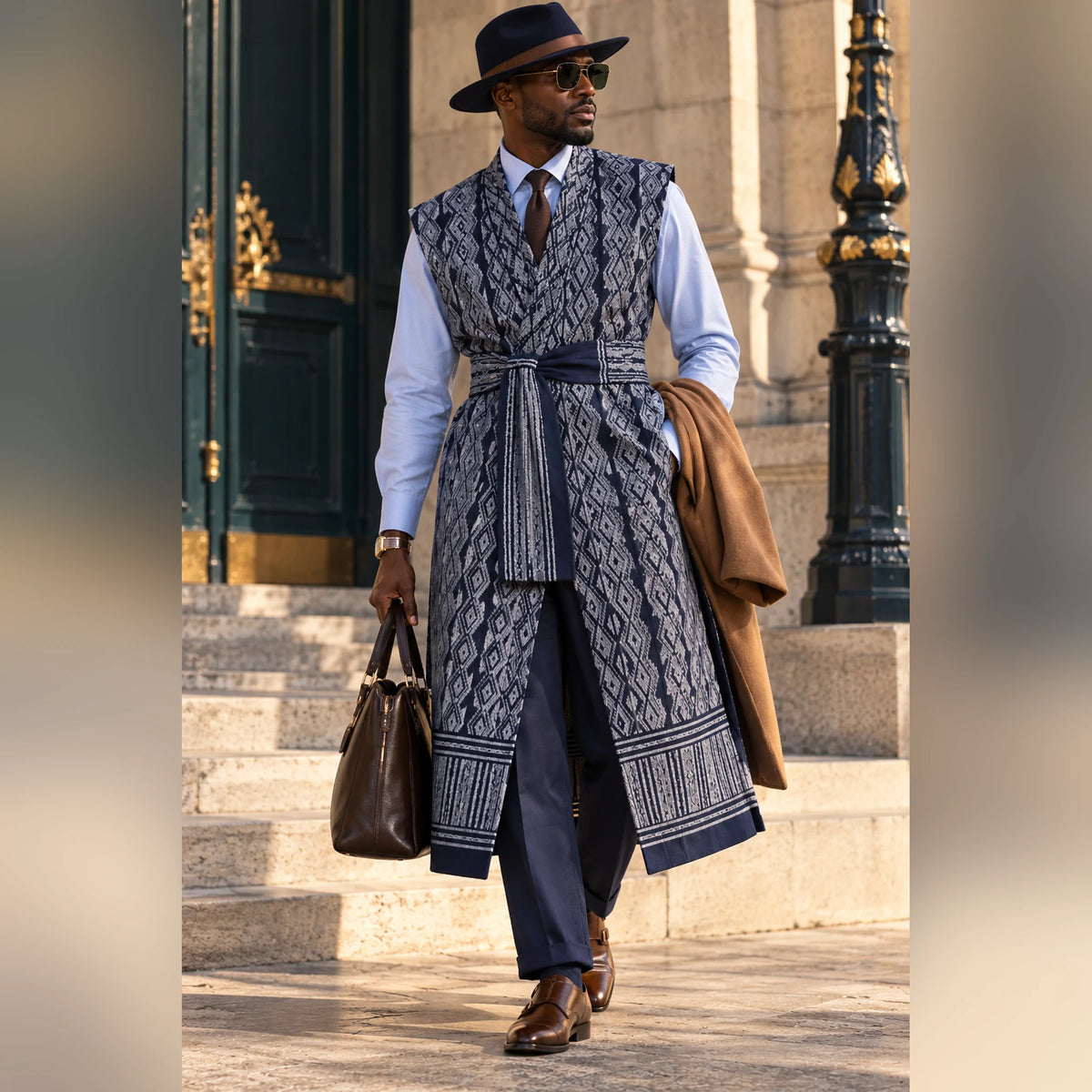
€159 for two vests in one: a unisex, reversible long vest in genuine 100% cotton African cloth. On the cloth side, the patterns take center stage; turned inside out, it shows mostly black cotton for a more understated look. Six colorways, three crafts: Serer cloth woven in Fadiouth, Manjak cloth woven in Dakar and bogolan (mud cloth) hand-painted in Mali.
Matching 8 cm (3¼ in) belt, two pockets and side vents: a long, polished and comfortable piece, made in Senegal, for women and men alike.
- Reversible: cloth side to make a statement, black cotton side for a more discreet look.
- Unisex: a long sleeveless cut designed for women and men.
- Side vents: they give you freedom of movement and an elegant, polished drape.
- Practical: two pockets and a removable 8 cm (3¼ in) belt, to wear it open or belted.
- 100% cotton: handmade cloth, lined with black cotton poplin.
Choose your cloth below, then add your vest to your cart.
Which cloth to choose? Six vests, three African crafts
Each of the three cloths has its own story, technique and character. The patterns are never printed: they are woven or painted by hand.
Serer cloth from Fadiouth: warm and easy to wear
Serer cloth comes from Fadiouth, the shell island on Senegal's Petite Côte, where a group of weavers weave it together. Its tight weave makes it a dense, durable fabric, with stripes and patterns created by the thread.
- Serer – orange, copper, black and ecru: the warmest, it brightens a plain outfit.
- Serer – black, gray and ecru: neutral tones, the easiest to wear every day.
Explore our full Serer handwoven cloth collection, including the LUMA large shopper bag, and the story of Serer cloth.
Manjak cloth from Dakar: refined and dressy
Manjak cloth is woven by hand in Dakar by our Manjak weavers, on narrow looms: the strips are then joined to form the fabric. It is a ceremonial cloth, recognizable by its dense geometric patterns, sometimes enhanced with shiny threads.
- Manjak – black and gold: the dressiest, with its golden threads, for evenings and ceremonies.
- Manjak – navy and gray: a sober navy blue with fine gray lines. The more discreet of our two blue Manjak vests, for everyday elegance, from the city to the office.
- Manjak – royal blue and cream: a deep royal blue covered with woven cream patterns (nested squares, diamonds and friezes), with a wide plain blue border at the hem. The more sophisticated of our two blue Manjak vests, for special occasions.
Explore our Manjak cloth collection, the Manjak bomber jacket, the Manjak kimono coat and the story of Manjak weaving.
Bogolan from Mali: graphic and timeless
Bogolan is cotton woven in strips in Mali, in Bamana country, then dyed and painted by hand with plants and earth. No two patterns are ever quite the same.
- Bogolan – black and white: ecru concentric squares on a black background, a bold graphic look to wear with plain pieces.
Explore our Bogolan from Mali collection, the black and white bogolan bomber jacket, the black and white bogolan kimono coat and the story of bogolan.
Still unsure? Our guide which African cloth to choose? will help you find yours.
Dimensions and fit
One size, sleeveless cut that suits many women's and men's body types. The belt lets you adjust the vest, especially on slimmer figures.
- Vest length: 118 cm (46½ in)
- Width laid flat: 56 cm (22 in)
- Belt: 175 cm (69 in) long, 8 cm (3¼ in) wide
Not sure about the fit? Compare with a vest or jacket you already wear, read our guide to sizes, silhouettes and cuts or write to us at kaolackrea@gmail.com.
Materials, reversibility and care
Cloth side: Serer or Manjak, 100% cotton woven by hand, or bogolan, cotton woven by hand then hand-painted with natural dyes. Reverse side: black cotton poplin. Turned inside out, the vest shows mostly black cotton: a new look without changing clothes.
Serer and Manjak cloth: wash at 30 °C (86 °F) maximum. Bogolan: cold wash only, preferably by hand, no bleach, to protect its natural dyes. For all: no tumble dryer, iron inside out.
Because the patterns are made by hand, their placement and shades may vary slightly from one vest to another.
Styling tips
On the cloth side, worn open over a white shirt or a plain turtleneck, it adds character to a city outfit. Belted, it defines the silhouette. Over a turtleneck, it works for fall and winter outfits, without replacing a warm coat.
On the black cotton side, it becomes more discreet: perfect for the office or to let a piece of jewelry stand out. Pair it with wide-leg pants, loafers, sneakers or ankle boots. Complete your look with a handcrafted Ndiaxass ring, a Guele Djiri necklace from Mali or our African earrings.
Frequently asked questions
Is this vest for women or for men?
Both: it is a unisex piece. Its long sleeveless cut suits women's and men's body types, and the belt lets you adjust the fit.
How does the reversible design work?
Simply turn the vest inside out. One side shows the cloth; the other is mostly black cotton. Two looks in a single garment.
What is the difference between Serer cloth, Manjak cloth and bogolan?
Serer cloth, woven in Fadiouth, is dense and warm, easy to wear every day. Manjak cloth, woven in Dakar, is more refined, with tight geometric patterns: it is the cloth for special occasions. Bogolan, from Mali, is hand-painted on woven cotton: its graphic look is bolder.
What is the difference between the two blue Manjak vests?
The navy and gray one is sober and discreet: a navy background with fine gray lines, easy to wear every day. The royal blue and cream one is brighter and more elaborate: cream geometric patterns cover the whole cloth, finished with a plain blue border, for a dressy look that gets noticed.
Does it have pockets?
Yes, two pockets.
What are the side vents for?
The vents make walking and moving easier and give the vest an elegant, polished drape, whether worn open or belted.
Can I wear it without the belt?
Yes, the 8 cm (3¼ in) belt is removable.
Are the patterns printed?
Never. On Serer and Manjak cloth, they are created by hand weaving. On bogolan, they are hand-painted on handwoven cotton.
Can I give it as a gift?
Yes, and it makes an ideal gift for a woman or a man. For her, it is a long, flowing piece to wear over a dress, pants or a turtleneck. For him, it is a bold, original garment to wear open over a turtleneck or a shirt. Its one size, adjustable belt and reversible design offer two styles in one gift, along with the story of a genuine handmade African cloth.
Where can I try it on in Paris?
At Kama The Shop, 51 rue Vauvenargues, 75018 Paris, Tuesday to Saturday from 11:30 am to 7:30 pm, Porte de Saint-Ouen metro station.
Also explore all our African jackets, coats and kimonos and all our African fashion.
Kaolack Créations
Since 2016, Kaolack Créations has brought to life a contemporary African fashion rooted in the continent's crafts. We choose genuine handmade African cloth, not printed patterns, to create distinctive pieces where textile heritage meets today's style. We work directly with our artisans over the long term and respect the prices they set. Every purchase helps value their work and pass on these crafts. Meet our artisans.